
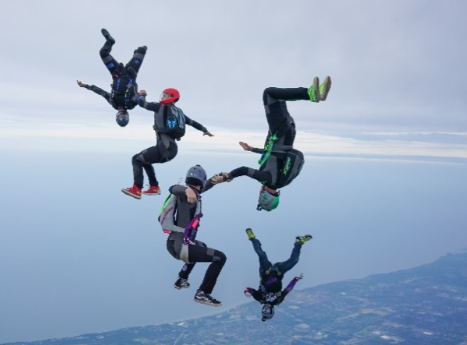
Skydiving is an exhilarating sport that combines adrenaline with teamwork, particularly in formation skydiving. If you’re curious about this dynamic type of skydiving, you’re in the right place! This post will guide you through the essential basics of formation skydiving, offering insights that will enhance your understanding and experience.
1. Understanding Formation Skydiving
Formation skydiving, often referred to as FS, involves a group of skydivers working together to create formations during free fall. Unlike solo skydiving, where the focus is on individual skill, FS emphasizes coordination and communication with other jumpers. Typically, formation skydiving teams consist of four or more people who aim to achieve a specific shape or pattern in the sky.
In formation skydiving, the primary goal is to maintain stability and alignment while executing precise maneuvers during the jump. Jumpers use body positioning and control to achieve this, relying on their training and experience. The jumps usually follow a methodology that is structured and rehearsed, making practice and teamwork essential components of success.
-
- Understand the basics of body position in free fall.
-
- Communicate clearly with your team before and during the jump.
-
- Practice formation stability on the ground with visual aids.
-
- Participate in drills to enhance group coordination.
2. Safety Measures in Formation Skydiving
Ensuring safety in formation skydiving is paramount, as the sport involves several jumpers in close proximity during free fall. Pre-jump briefings are crucial for establishing safety protocols and discussing individual roles in the formation. All team members should be aware of emergency procedures and have a clear understanding of what to do in case the jump doesn’t go as planned.
Great attention should also be given to skydiving gear. Each member’s equipment must be properly maintained and regularly checked to prevent malfunctions. Settings for deploying parachutes and altimeters should be confirmed before every jump, ensuring that everyone is prepared for the landing sequence.
-
- Always conduct a team briefing before each jump.
-
- Inspect equipment thoroughly for safety compliance.
-
- Practice emergency protocols consistently.
-
- Establish a “follow-me” signal for coordination in the air.
3. The Training Process for Formation Skydiving
Training for formation skydiving is an essential step for anyone looking to join in this thrilling discipline. Skydivers typically start with tandem jumps or basic solo jumps to get accustomed to free-fall and parachute deployment before transitioning to formation jumps. Most skydiving schools offer specific courses tailored for formation skydiving, including both theoretical and practical training.
During training, jumpers not only master free-fall techniques but also learn how to work as a cohesive unit. This often involves practicing specific formations in the air and using visual aids on the ground to map out procedures. Advanced jumpers may also consider competing in formation skydiving competitions, which require even higher levels of skill and precision.
-
- Sign up for a formation skydiving course at a reputable school.
-
- Practice regularly to enhance skills and build team dynamics.
-
- Film jumps for review and constructive feedback.
-
- Join a local formation skydiving team for additional practice.
4. Tips for New Skydivers in Formation Skydiving
If you’re a new skydiver excited about learning formation skydiving, there are some practical tips to help you along the way. One of the most important aspects is mastering your own body control. Understanding how your movements affect others around you can minimize potential collisions and improve the overall experience. Starting with small groups can help ease the transition to larger formations.
Another key to success in formation skydiving is to develop strong communication skills, both in the air and on the ground. Make sure that each team member understands hand signals and verbal cues. Practicing these consistently will help your team build familiarity and improve performance during the jumps. Remember, practice makes perfect!
-
- Focus on body control techniques to improve stability.
-
- Establish clear communication signals with your team.
-
- Start with small formations before advancing to larger groups.
-
- Pay attention to the strategies of more experienced jumpers.
In conclusion, formation skydiving is a thrilling and rewarding experience that relies heavily on teamwork, practice, and safety. If you’re eager to take the plunge, consult with an experienced instructor or a local skydiving community to get started on this incredible journey! Whether you’re a novice or experienced jumper, there is always something new to learn in the world of skydiving.