
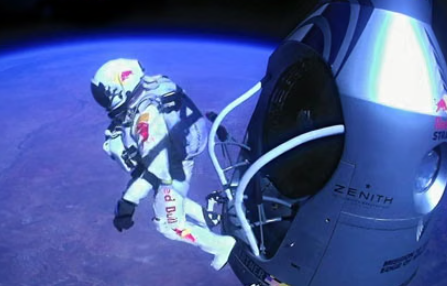
On October 14, 2012, Austrian skydiver Felix Baumgartner made history with his spectacular jump from the edge of space, breaking multiple world records in the process. His feat captured the imagination of millions worldwide and showcased not only incredible human courage but also the advancements in aerospace technology. In this post, we will explore the remarkable details of Baumgartner’s jump and the records he shattered.
1. The Jump and Its Preparation
Before his monumental leap, Baumgartner underwent extensive training and preparation. The project, named Red Bull Stratos, began as an ambitious plan to reach the stratosphere using a helium-filled balloon. The ascent took nearly three hours, allowing Baumgartner to climb to an altitude of 128,100 feet (39,045 meters), where he experienced an environment so thin that it was almost a vacuum. The preparation included numerous test jumps, advanced simulations, and the development of a specialized suit designed to withstand the extreme conditions of high altitude.
Baumgartner’s training included regular jumps from high altitudes and working closely with scientists and engineers who monitored every detail of the ascent and the jump itself. The primary goal was to safely achieve freefall and gather vital data on human limits at high altitudes. This preparation paid off as he successfully performed his jump, breaking records while demonstrating the limits of human capabilities.
-
- Engage in physical training to improve stamina.
-
- Familiarize yourself with the equipment used, including parachutes and suits.
-
- Undergo psychological training to cope with extreme situations.
-
- Participate in mock jumps to practice scenarios and safety protocols.
2. Records Broken by Felix Baumgartner
During his jump, Baumgartner not only achieved a landmark event but also set several significant records. He became the first person to break the sound barrier without the aid of a vehicle, reaching a maximum speed of 843.6 mph (1,357.6 km/h) during freefall. This was a stunning achievement since the effects of increased speed and pressure can be incredibly taxing on the human body. Additionally, he set the record for the highest freefall and the highest manned balloon flight.
These records highlight the extreme conditions and dangers faced during high-altitude jumps. Each of these milestones required precise calculations and a deep understanding of the physics involved. The drop from such a significant altitude involved potential risks such as hypoxia, rapid decompression, and parachute failure. Baumgartner’s ability to manage these challenges demonstrated not just bravery but also expert training and technology’s role in safety.
-
- Understand the significance of breaking the sound barrier.
-
- Analyze the factors that contributed to the jump’s success.
-
- Review the safety measures taken before and during the jump.
-
- Consider the implications for future space exploration and human limits.
3. The Impact on Science and Technology
Baumgartner’s jump also had profound implications for both scientific research and technological advancements. Data collected during the jump provided invaluable insights into high-altitude jumps, which can be applied to both military and civilian aviation. It highlighted the importance of safety in extreme conditions and opened up discussions about the future of space exploration and parachute technology, which can benefit from the lessons learned.
The event also sparked increased interest in the fields of aerospace engineering and space tourism, proving that we could push the boundaries of human potential. More than just a spectacular stunt, Baumgartner’s jump served as a significant case study for researchers and innovators. Many companies have since explored developments in suits and vehicles for high-altitude and space missions, inspired by the success of Red Bull Stratos.
-
- Research advancements in aerospace technology since the jump.
-
- Consider the safety implications for future high-altitude endeavors.
-
- Explore opportunities in space tourism and its future replacements.
-
- Engage with companies innovating in related fields through forums or discussions.
In conclusion, Felix Baumgartner’s jump was not just an extraordinary physical achievement but also a monumental step in human understanding of high-altitude flight. The dedication and preparation leading up to the event set a benchmark for future explorations beyond our atmosphere. If you’re interested in aerospace technologies or extreme sports, consider diving deeper into this fascinating subject to discover all the nuances and future paths it can offer!